
Norway, a global leader in carbon reduction, has been actively transitioning itself towards zero-emission from vehicles, construction, and many key industries. In the capital city of Oslo, major construction works are ongoing, but the equipment on site such as excavators, diggers, and loaders, are electric-powered.
The use of all-electric machinery will intensely reduce emissions and noise pollution. The presence of more sidewalk is evidence that the city is showcasing a pilot project for the initial zero-emission city construction spot in the world.
Local residents passing by Oslo’s Olav V gate and Klingenberggata, quoted by media reports, have said that they had been impressed with the zero-emission construction effort, pointing out that big machines were practically noiseless and they could not even tell whether the machines had been turned on or off.
Philip Mortensen, a senior adviser at the City of Oslo’s Climate Agency, said the agency focused on safer working environment for construction by ensuring low ambient noise level and pollution. “Shops remain open towards the street, despite the ongoing construction work just outside on the pavement,” said Mortensen.
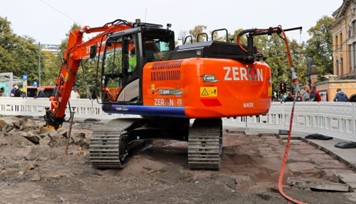
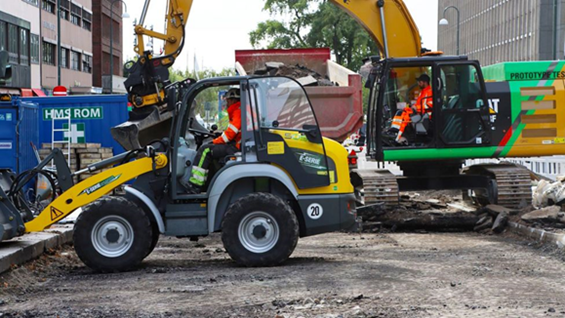
The electric machinery, construction site, Olav V’s gate, Oslo, Norway. (Credit: Climate Agency, Oslo)
Moving towards the net zero ambition, another six of Norway’s biggest cities have similar commitment and goals as Oslo’s. With the intermittent benefit of an electricity grid with 98% renewable energy – mostly from hydropower – Norway is an ideal zero-emission testing sites.
How Norway moves toward its net zero ambition from the energy sector
The Norwegian Government has requested Equinor, a Norwegian energy company with more than 50 years of experience, as well as the industry to further strengthen the ambition level for 2030 from 40% to 50%. Equinor is aiming to be an industry leader in carbon efficiency through plans to reduce greenhouse gas emissions from its operated offshore fields and onshore plants in Norway by 40% by 2030, 70% by 2040 and to near zero by 2050.
An Equinor representative from Corporate Sustainability on 10th August confirmed its climate ambition progress, saying the company is in line with Norway’s target to reduce carbon emission from oil and gas by using advance technology in Carbon Capture Utilisation and Storage (CCUS).
“The Norwegian Authorities strongly supports the funding, and a project that involves Shell and Total in Northern Light project is ongoing. The project will be the first and largest CCUS project in the world. The renewable electrification off the offshore oil and gas sector is the main contribution of reducing carbon emission going forward, with ongoing acceleration and studies,” she said.
Equinor is using cable from onshore with renewable electricity from hydropower, the representative said from the company’s office in Oslo. “The use of electricity from the grid is providing electricity to offshore installation from onshore and will gradually replace the gas we use today. A big change, from natural gas to renewable electricity.”
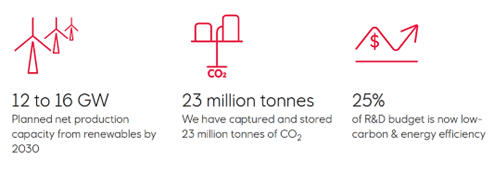
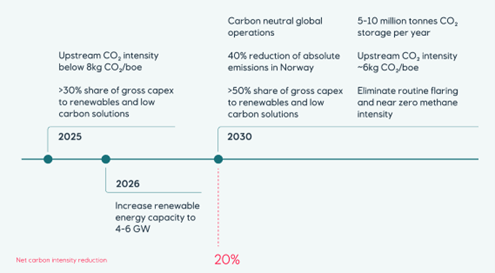
Credit: https://www.equinor.com/en/what-we-do/renewables.html
Enry Horas Sihombing, an Indonesian geologist and PhD candidate in Earth Science at Norway’s University of Bergen, said he commended the country’s energy management by placing oil and gas as the commodity of economy despite being a prolific global oil and gas producer.
“Norway has been known as a prolific oil and gas producer, but it is placed as the commodity of economy. For the last 20-30 years, Norway has utilized renewable energy for local usage, such as hydropower electricity. Most of the electricity (98%) is generated by renewable power, placing the oil and gas as export commodity only,” Sihombing said.
He said there are more energy projects associated with carbon capture utilization and storage (CCUS). “CCUS is now in the portfolio of major oil companies in Norway. They also involve some universities to implement the project, shown by several PhD opening in CCUS.”
Technical expertise in geology could be applied not only in oil and gas but also in renewable or green energy. “In oil and gas operation, we drill a well to produce something, while for the CCUS, we drill a well to store the carbon. We evaluate the reservoir whether it is a proper storage for the carbon,” said Sihombing.
He also pointed out that other countries – including his native homeland of Indonesia – could learn from Norway about renewable energy development in order to reduce world carbon emission.
“Norway considers oil and gas as a commodity to generate revenue as their resource is unlimited. But they know that to be a sustainable country, they must have a sustainable energy by utilising renewable energy locally while fulfilling the energy demand as a way to have an energy resilience,” Sihombing said.
The Indonesian government, noted Sihombing, should focus on becoming an energy-resilient nation by optimizing renewable energy – and significantly reduce its reliance on fossil-fuel energy such as coal and oil and gas – if the world’s fourth largest nation actually do strive to be a sustainable country that cares for global warming.
This is critical because despite Indonesia’s pledge on its commitment to the Paris Agreement in early August, many government institutions and industries are reluctant to stop using coal. For the first time since 2016, Indonesia updated its nationally determined contribution (NDC) to the agreement and pledged to independently reduce emissions by 29 percent or by 41 percent with international assistance by 2030 and achieve a unified net-zero target by 2060.
“We must consider energy as a source for building a sustainable country. It means we must utilise energy not only as an element for generating revenue but also to sustain our country,” he said, adding that the use of affordable local gas for local industry could potentially boost economic growth.
 The Lens of Energy & Sustainability
Leave a comment