Maximizing renewable energy while supporting the country’s low carbon emission programme for the energy transition, is a massive opportunity. However, like other extractive industries, operating adjacent to the community also comes with massive challenges. Operational risk, environmental, social impact and media news are complementary.
Despite constant improvements in many aspects, negative news is sometimes inevitable – often contains inaccurate, unverified, imbalanced information, and quotes from implausible sources which led to disinformation. What makes it more intricate? Unsuitable use of words in the news report. This condition might have been rooted in some journalists’ lack of understanding of the specific industry, including common relevant technical terms, causing irrelevant use of phrases in the news and conclusion, such as “gas leak from the company X” without using “the alleged,” while the investigation of the root cause is still ongoing. Then “gas pipe leak,” “hot mud flow”, especially when some journalists associated the occurrence with the mudflow in East Java in 2006, an oil and gas case – different from geothermal.
Obviously, improving the journalists’ knowledge of the industry to improve the quality of their work, especially in local areas, is crucial. This includes Mandailing Natal regency, North Sumatra, where one of KS Orka Renewables geothermal projects is present in Indonesia.
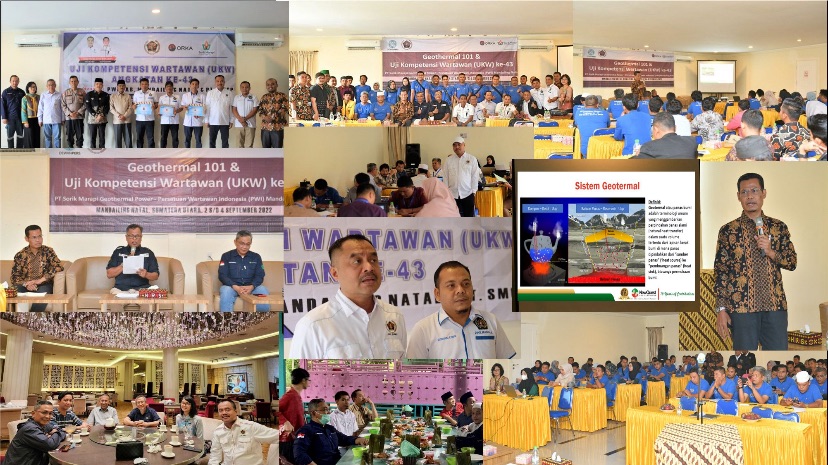
The past few months have been dynamic, yet abundant. Amidst the challenges surrounding the working site – some could consider it “a remote area”, and after a series of journeys, finally, KS Orka in partnership with the Indonesian Journalists Association (PWI) Mandailing Natal, hosted a series of programmes for local journalists in August – September 2022, comprising media capacity building, journalists’ competency, and numerous discussions.
The journalists’ competency test – Uji Kompetensi Wartawan, became the FIRST one hosted in the regency. Followed by The Geothermal 101 by Dr. Yunus Daud from Universitas Indonesia, continued with an overview by the company’s Operations Support Manager, regarding the operations risks, mitigation, and CSR. Also, a sharing session on local media discourse, involving the PWI North Sumatra Province, Press Council reps, local government and student organisations.
Overtime, the growing numbers of better-quality news from local media, have implied better journalists’ work, of course, manifests in the news that meets the ethic codes of journalism: factual, impartial, balanced, with credible sources.
Nurturing a good relationship with regional journalists and media through capacity building is vital. Not about making news to be seemed positive or negative when it was not. Neither for the sake of companies’ reputation. With the companies’ understanding of the need to support sustaining ethical journalism practices, hopefully, things will be about telling the fact. Nothing but the fact.
 The Lens of Energy & Sustainability
Leave a comment